You Don’t Need a Kitchen
This is one of my favorite memories. We weren’t at a campsite. We weren’t at a cabin. We didn’t have a full setup.
We just stopped.
Somewhere with a picnic table, a small grill, and water in the background. And we made food anyway.
There’s this idea that if you’re traveling with food restrictions, everything has to be planned perfectly.
You need the right place, the right setup, the right timing. And if you don’t have those things, you wait. Or you skip it. Or you settle.
But this day wasn’t like that.
We had what we had—ground beef, a simple grill, and whatever was already in the car.
So we made burgers.
Nothing fancy. Nothing complicated. Just food.
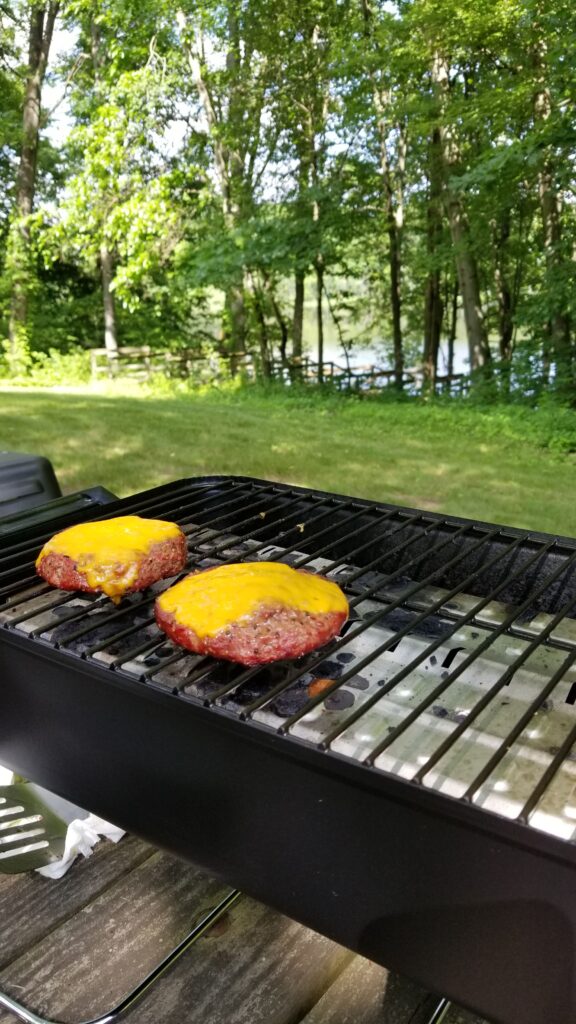
And honestly, even looking at this picture now, I can tell exactly how this came together.
The cheese doesn’t even fit the burgers, which tells me I didn’t plan for burgers at all. I just had sliced cheese with me for snacks.
We stopped, decided to cook, and I probably said, “Oh, I have cheese.” And that was good enough.
We definitely didn’t have buns.
No full setup. No extras.
And that’s normal.
Most of the time when we travel, I’m not trying to recreate a perfect meal. I’m just trying to make something that works.
I almost always have a big salad with me—some kind of lettuce, maybe tomatoes, whatever vegetables I could grab.
So chances are, that’s what this turned into.
A bunless burger on top of a salad.
Protein, something fresh, and a meal that actually holds you over. And that’s really the point.
Traveling with food allergies or dietary restrictions can make you feel like everything has to be controlled.
Like if it’s not just right, it’s not possible.
But it is.
It doesn’t have to be perfect.
It just has to work.
Sometimes it’s a full setup with everything prepped and ready.
And sometimes it’s two hand-formed burger patties on a random grill by the water, with snack cheese that wasn’t even meant for this.
Both count.
Both are valid.
And both mean you didn’t let your limitations keep you from living your life.
This isn’t about burgers. It’s about learning to work with what you have—and trusting that it’s enough. Because most of the time, it is.